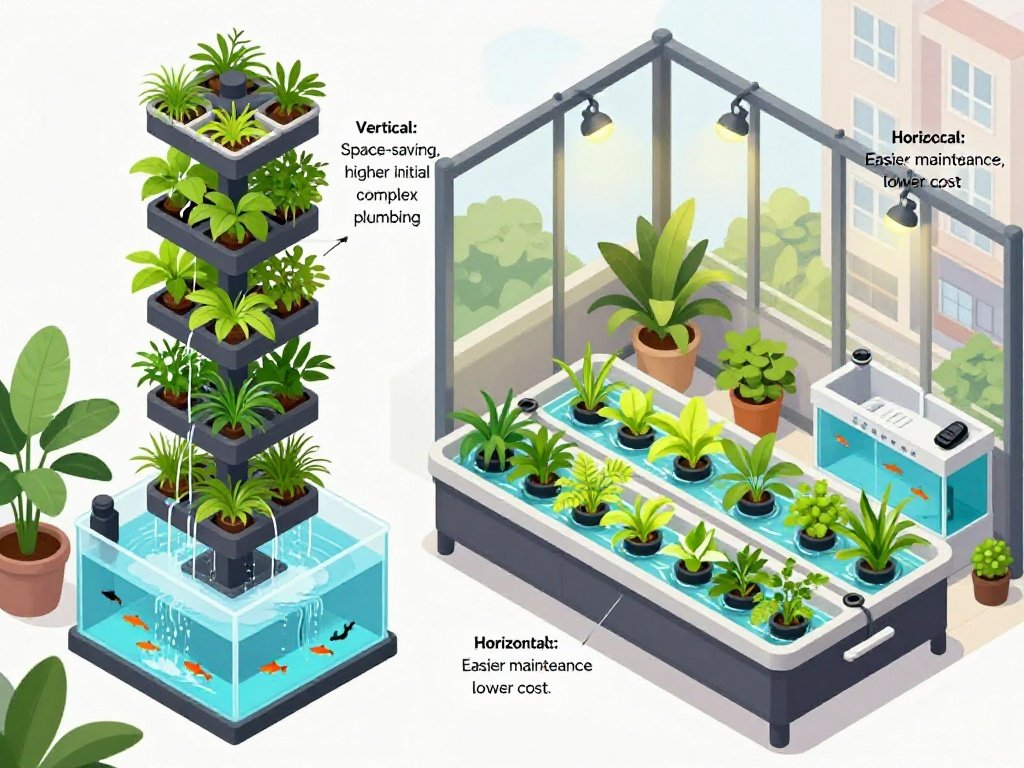
Vertical vs. Horizontal: Design Trade‑offs for Small‑Space Aquaponics
If you’re dreaming of fresh herbs and crisp lettuce but only have a balcony, a corner of the garage, or a spare closet to work with, you’ve probably asked yourself: “Should I go tall or go wide?” The answer isn’t one‑size‑fits‑all—it depends on your space, your budget, and what you want to grow. Let’s break down the real‑world pros and cons of vertical towers versus horizontal raft/NFT channels so you can pick the layout that fits your life (and your lettuce cravings).
🌱 The Vertical Approach: Think “Skyscraper Farm”
What it looks like: Stacked buckets, PVC towers, or hanging gutters where plants grow in pockets or net cups arranged one above the other. Water usually trickles down from the top, feeding each level as it goes.
Why people love it
- Maximum density in a tiny footprint – You can grow 20+ lettuce heads in less than 2 square feet.
- Great for balconies or indoor corners – Utilizes vertical space that would otherwise be empty.
- Visually striking – A living wall of green makes a cool conversation piece.
- Easier to protect from pests – Elevating plants can keep some ground‑dwelling bugs at bay.
The trade‑offs you’ll notice
- Light distribution gets tricky – The top layer hogs the sunshine (or grow lights), leaving lower levels shaded. You may need supplemental side‑lighting or rotate towers regularly.
- Root zone limits – Net cups or small pockets give roots less room to sprawl; heavy feeders like tomatoes or cucumbers can become root‑bound.
- Water flow consistency – Ensuring each level gets enough flow (and not too much) can require careful tuning of pump speed and pipe diameters.
- Harvesting can be a bit acrobatic – Reaching the top tier might mean a step stool; harvesting the bottom often means bending or disassembling part of the stack.
Best for: Leafy greens, herbs, strawberries, and any lightweight, fast‑growing crop that doesn’t need massive root space.
⛅ The Horizontal Approach: Think “Greenhouse Bed”
What it looks like: Long, shallow channels (NFT), floating rafts (DWC), or wide grow beds where plants sit in a single layer, their roots dangling in nutrient‑rich water that flows horizontally.
Why people love it
- Stable, spacious root environment – Plants can develop extensive root systems, which translates to better nutrient uptake and bigger yields for fruiting crops.
- Even light exposure – Every plant gets roughly the same amount of light (assuming your overhead lighting is uniform).
- Simple harvesting and maintenance – You can walk alongside the channels, lift rafts, or slide out net cups without climbing.
- Easier to scale – Adding another channel is just a matter of extending the pipe and pump capacity.
The trade‑offs you’ll notice
- Takes up more floor space – To get the same number of plants as a vertical tower, you’ll need a longer footprint.
- Requires a level base – Uneven flooring can cause pooling or dry spots in the channels.
- Potential for algae growth – Wide, shallow water surfaces can invite algae if light hits the water directly; you’ll need to cover or shade the channels.
- Heavier when filled with water – A 4‑foot raft bed full of water and plants can weigh dozens of pounds—make sure your floor or table can handle it.
Best for: Larger leafy greens (like romaine or kale), herbs that like room to spread, and fruiting plants such as peppers, tomatoes, or cucumbers (provided you have adequate support).
📋 Quick Decision Checklist
| Question | If Yes, lean toward … |
|---|---|
| Do I have less than 2 sq ft of floor area? | Vertical |
| Am I growing mostly herbs and leafy greens? | Vertical (or either) |
| Do I want to grow tomatoes, peppers, or cucumbers? | Horizontal |
| Is my ceiling height limited (e.g., a closet grow)? | Horizontal (vertical needs headroom for towers) |
| Do I have a sturdy table or shelf that can hold 30‑50 lbs of water? | Either (just check load capacity) |
| Am I okay with adding side‑lights or rotating towers? | Vertical |
| Do I prefer a “set‑and‑forget” flow with minimal tweaking? | Horizontal |
🛠️ A Hybrid Hint
Many small‑space growers end up mixing both: a vertical tower for basil and mint along the wall, and a short horizontal NFT channel for lettuce and microgreens on a shelf below. This gives you the best of both worlds—high density where light is strong, and spacious root zones where you have a bit more floor to spare.
🌿 Final Thought
There’s no “right” layout—only the one that matches your current constraints and your future goals. Start small, observe how your plants respond (check leaf color, root health, and growth speed), and don’t be afraid to tweak or rebuild as you learn. After all, aquaponics is as much about the journey as it is about the harvest.
Got a setup you’re proud of? Drop a photo in the comments and tell us why you chose vertical or horizontal—I love seeing how everyone makes the system work for their space!
Leave a Reply